
Middle Township Past Residents Coverage
Different records answer different parts of the question. Deeds establish a transfer chain; newspapers and directories can put people and names near an address; census schedules capture households at dated intervals; permits show property activity; and probate or obituaries can help close a historical trail. None alone makes a continuous list of everyone who lived at a house.
| Record layer | Verified local coverage | Access point | What it can establish |
|---|---|---|---|
| County Clerk deeds and mortgages | Some deed and mortgage series from January 1, 1996; general electronic records from August 12, 2000 | Cape May County Clerk NewVision online, then Record Room | Transfer parties, recording information, legal description, and document details |
| Older deed and mortgage indexes | From 1692 | Cape May County Archives and Record Room | Earlier chain-of-title instruments and physical or microfilm indexes |
| County archive census | 1850, 1860, 1865, 1870 | County Archives | Household and place snapshots before later released federal schedules |
| Regional directory lead | Boyd's 1897-98 | New Jersey State Library finding aid and microfilm | Regional names and businesses; township coverage must be inspected |
| History Online newspapers | Herald 1901-1909; Star and Wave 1908-1943 | Cape May County Library digital viewer | Notices, deaths, marriages, local names, streets, and events |
| Sanborn map | October 1905, three sheets | Library of Congress | Building and street context, not a resident roster |
For recent transfers, begin online. For an older property or a gap in the electronic index, start at the Record Room with a legal description and prior document reference. For a household question, add census, newspapers, and any confirmed directory source instead of assuming the owner was the occupant.
Middle Township Past Residents Parcel Anchor
The first record to preserve is the legal parcel, not a remembered surname. In Cape May County PRESS, set Municipality Name to Middle Township and search by current owner, street/address, or block, lot, and qualifier. PRESS can show current owner information, the map, tax identity, current and prior deed or sale records, and related county property results. It is a current-owner tool, not a prior-owner index or a title search.
Middle Township is municipal code 0506 in the County GIS. Keep the current situs address, tax mailing address, municipal code, block, lot, qualifier, subdivision or lot description, and historic street aliases together in a research log. Block and lot can change after subdivision or condominium qualification, and the tax mailing address can differ from the physical address.
Research limit. The name on a tax parcel does not automatically prove who lived there. It identifies a legal owner or tax mailing contact, while other occupants and household members are not exposed just because the parcel is public. That distinction is central to a responsible past-residents search.
Middle Township Past Residents Deed Chain
The ownership trail uses the Cape May County Clerk's Land Records Public Search / NewVision index together with PRESS. The Clerk interface accepts Party Name in Last-Name First-Name order, town, date range, document type, book and page, lot and block, legal-description, map, parcel, and related modes. Use the current deed as a bridge to the prior seller, rather than relying on a street-address result alone.
- Use PRESS to record the current owner, municipality, block and lot or qualifier, and the parcel's deed or sale clue.
- In NewVision, search the current buyer as grantee, then narrow by Middle Township, date, document type, or document reference.
- Open the verified result and record the seller or grantor, recording date, consideration where shown, book or page or file number, and the legal description.
- Search that seller as an earlier grantee to locate the preceding purchase, then repeat the same documented step.
- When a reference leads before the online coverage, take the book, page, file number, or legal description to the Record Room and physical index.
- Grantor / grantee
- The grantor is the party transferring an interest; the grantee is the party receiving it. Names must be checked in the role and date of the particular document.
- Chain of title
- The linked sequence of recorded transfers connecting an identified parcel through time. It is an ownership trail, not a list of occupants.
- Legal description
- The parcel wording, lot reference, or other formal property identification in a recorded document. It is often a stronger bridge than a historic street label.
- Criss-cross directory
- An address- or street-ordered directory arrangement that may help identify a household, but only if a particular volume includes that section.
- Enumeration district
- The geographic unit used to organize a census. It can help locate a place in a census year but does not replace address verification.
Middle Township Past Residents Online Cutoffs
The online cutoff is not one date. The Cape May County Clerk states that general electronic land-record documents extend from August 12, 2000, while deeds, mortgages, mortgage discharges, and subdivision maps include some series beginning January 1, 1996. A blank web result can therefore reflect the coverage boundary, an older physical book, a spelling variant, a document type, or a changed parcel identifier.
NewVision results identify party, document type, file number, recording date and time, town, and in appropriate modes book and page, lot and block, map, parcel, or case and parcel. The Clerk also flags R for a replaced record, C for a correction record, and may display a sealed page for a Daniel's Law covered person. Treat each label as a records-access boundary, not as a reason to seek a workaround.
Middle Township Past Residents Record Room
For older deeds, the County Clerk's Record Room and archives at 7 N. Main Street, Cape May Court House hold the physical and archival layer. Self-directed searchers are generally served Monday through Friday, 9 a.m. to 4 p.m.; staff-assisted research requires an appointment. Call 609-465-1023 for public-record access or 609-465-1010 for the main office, or email coclerk@co.cape-may.nj.us before a visit.
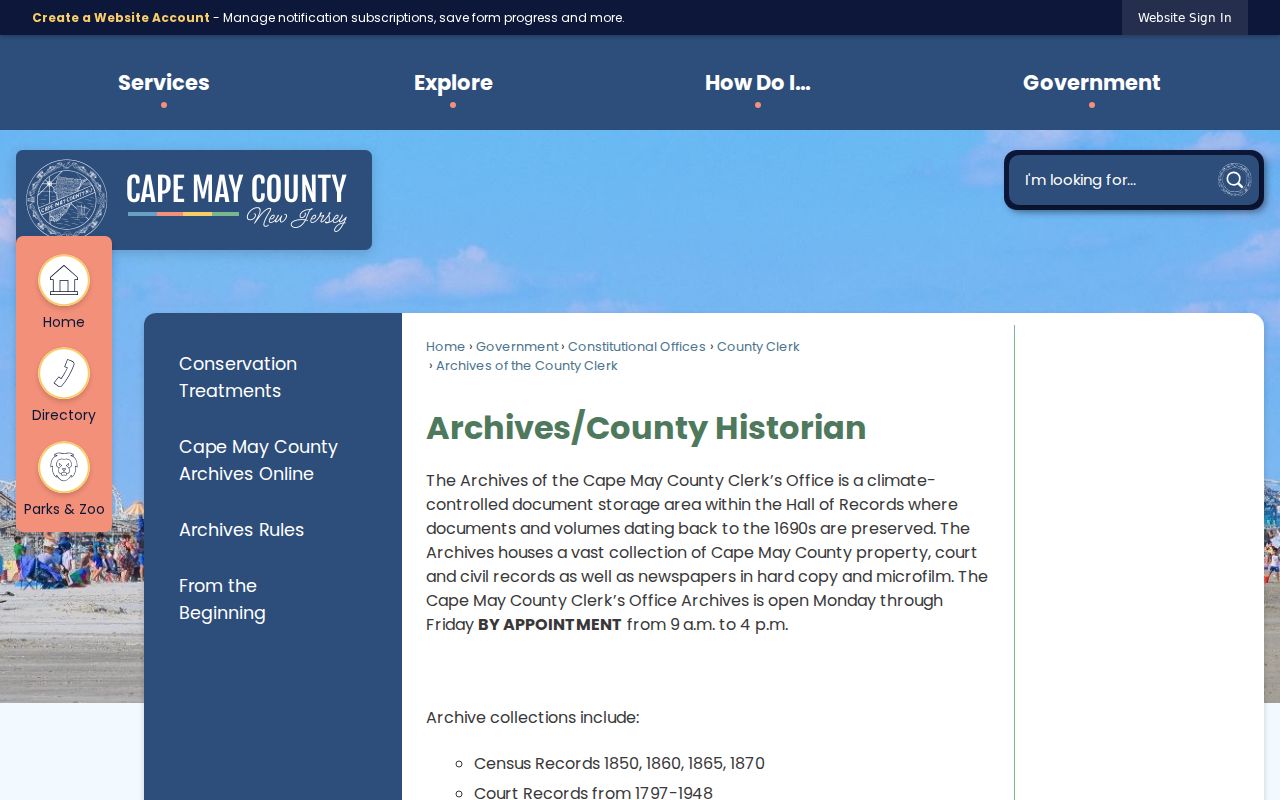
The County Archives information route describes collections and appointment access for the older layer. Bring the latest confirmed book and page or file number, property aliases, block and lot, and a reasonable date range. The Clerk's collection reaches back to 1692, but the right research question is whether a particular instrument or index covers the address, not whether every historic occupant is named in archives.
Copy requests have documented county channels: in-person self-service copies are $0.05 per page, certified copies are $1 per page plus a $10 certification charge, faxed non-certified copies are $2 per page, and mail copies are $0.05 per page with an envelope. Confirm the current fee and the document's availability with the Clerk before ordering.
State Archives Address Trail
New Jersey State Archives search and appointment information provides the statewide layer when a Middle Township address question reaches colonial, statewide, or centralized series. Its holdings include land, probate, military, and state-level vital-record material, while the county archive remains the closer source for Cape May County books, maps, and local indexes.
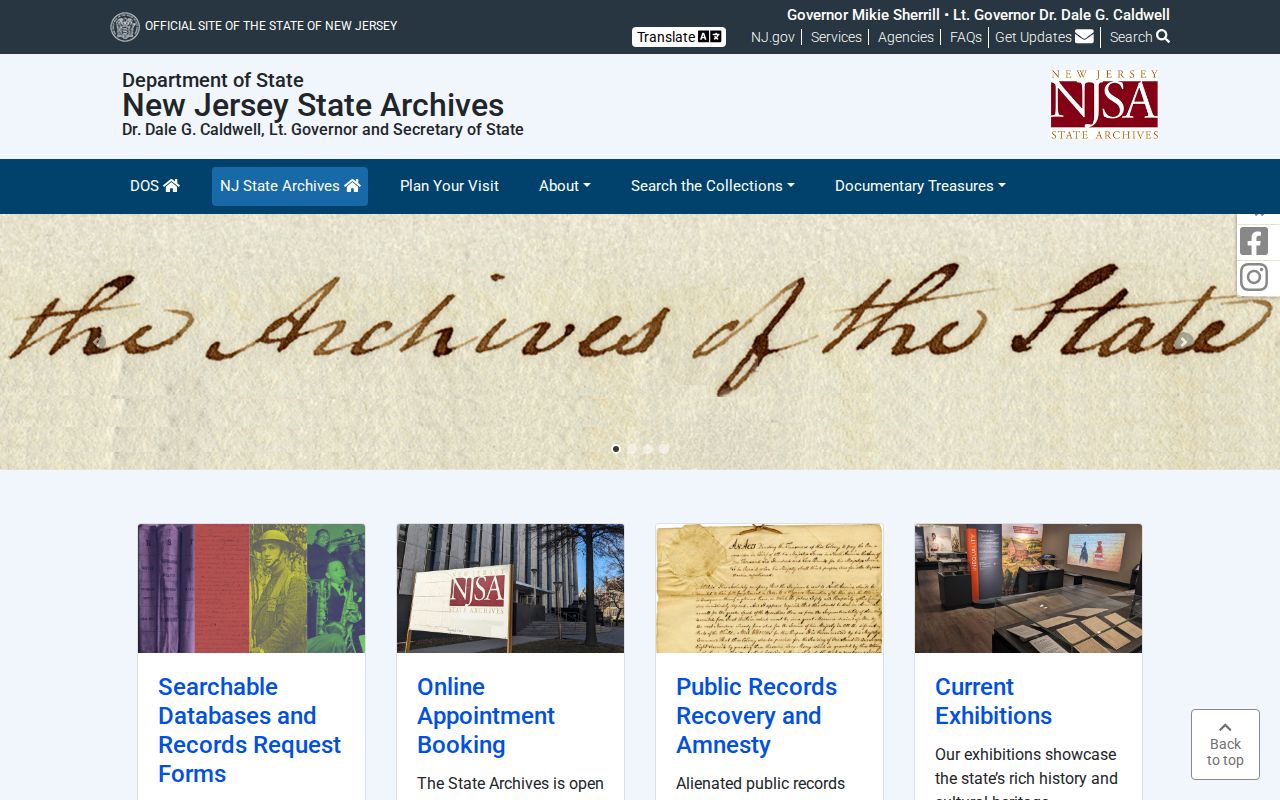
For vital-record research, New Jersey State Archives holds state-level births through 1924 and marriages and deaths through 1950. State Department of Health registry holdings begin later for several series, and access depends on the event type, date, proof, and relationship rules. Confirm the exact collection and image restriction before treating an archive catalog result as a usable record.
Middle Township Past Residents Household Sources
Ownership is only one layer of house history. A directory, census schedule, newspaper, obituary, or local notice may put a person at an address or in a community on a date, but the research did not verify a continuous Middle Township directory run. Use the regional Boyd's 1897-98 lead and county catalog leads selectively, then consult the full collection workflow on the Middle Township city directories page.
- Start from a confirmed deed date or address form and search the nearest directory or newspaper period using community and surname variants.
- Pair 1897-98 directory material with the 1900 federal census, then compare later dated clues with the 1910 through 1950 released federal schedules.
- Use the county archive census snapshots from 1850, 1860, 1865, and 1870 when the address period reaches that layer.
- Search History Online for surnames, initials, street fragments, churches, cemeteries, and Cape May Court House, then browse the issues around a relevant event.
- Record the publication title, issue date, page, address wording, and any uncertainty. OCR matches are leads that need a visual page check.
The Cape May Herald contributes 462 issues from 1901 to 1909, and the Star and Wave 603 issues from 1908 to 1943. Their overlap can corroborate a local notice, but no one hit proves a complete household or uninterrupted residency.
Middle Township 1905 Sanborn Context
The verified Cape May Court House Sanborn Fire Insurance Map is dated October 1905 and contains three sheets. Use its sheet index and historic street names to locate the structure, then compare the footprint, construction details, business labels, and street setting with a current parcel map and the 1905-1910 newspaper or census trail. A map can establish physical context, not a person at the address.
No additional Middle Township-specific Sanborn year was verified. It is therefore important not to turn the 1905 sheets into a claimed continuous local map series. A changed footprint may raise a useful question about construction or use, but it needs a permit, deed, tax, or archival record for confirmation.
Past Residents Permit Dates
Construction, zoning, code, and permit records can date a build, alteration, demolition, or change in use and may identify an applicant or owner. The exact Middle Township online permit start date, search fields, coverage, and fee schedule were not located in the research. Request permit cards, inspection logs, certificates of occupancy, and zoning or land-use approvals through the township custodian or by a New Jersey Open Public Records Act (OPRA) request, using the exact address and date range.
A contractor name, utility hookup, or project address should not be turned into a resident claim. Utility-customer information is not a public resident directory unless it is present in a specific public district or project file. Preserve the source type and the limitation beside every note.
Past Residents Obituary and Probate
When a historic household disappears from an address trail, an obituary, cemetery record, deed, or estate file can supply a later endpoint. Cape May County History Online offers searchable newspaper runs; the Museum of Cape May County cemetery database is a genealogical lead that should be checked against an obituary or probate source. The County Surrogate, at 9 N. Main Street in Cape May Court House, handles probate, administration, surviving-spouse, and next-of-kin filings and can be reached at 609-463-6666.
Probate records may identify an executor, heirs, addresses, and property connections, but confidential or sealed matters remain subject to Surrogate and court rules. Appointments are required or strongly urged. Match a deceased person's last known address and property identity to the deed chain before concluding that an estate relates to the house.
Middle Township Past Residents Privacy
Historic research has firm boundaries. New Jersey's Address Confidentiality Program can provide a legal substitute address for qualifying participants, and Daniel's Law can result in a sealed-page land-record outcome. Census release dates, sealed court material, confidential probate content, and the absence of public utility or household rolls also create real gaps in an address trail.
Lawful personal use. Middle Township past residents research is appropriate for house history, family history, estate or heir questions, civic curiosity, and reconnecting through lawful channels. Do not use an address trail to watch, harass, intimidate, or harm a living person.
When a fact matters, confirm it with the County Clerk, archive, library, Surrogate, township custodian, or other office that holds the underlying record. The research path is strongest when every conclusion remains tied to its date, source, and limits.